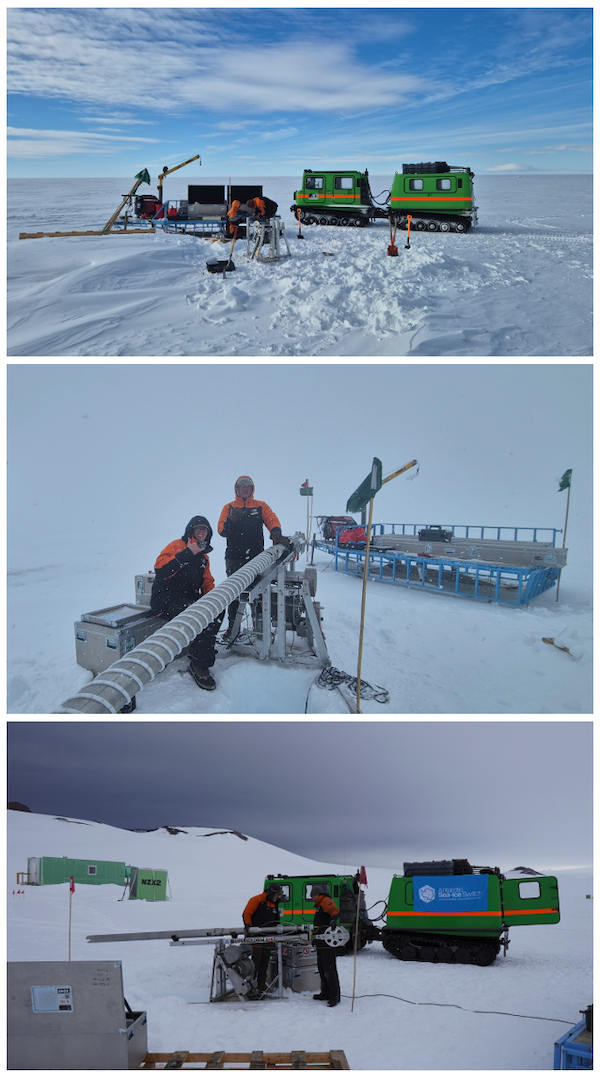
Our light-weight, ice core drilling system has been field tested in Antarctica by our team, and we’re ready to drill an ice core from Whitehall Glacier in Antarctica.
Research goal
A key aim for the ‘Past Baselines’ research team is to quantify the natural variability in Western Ross Sea sea-ice for the last 250+ years. To achieve this goal, we will be collecting a 250m ice core from Whitehall Glacier, a remote location some 550 km north of Scott Base.
It snows a lot at Whitehall, up to 2 metres per year, which means that the ice core will be very ‘high-resolution’, containing a very high amount of information per yearly unit. The flip-side to this is that we will need to collect quite a long core to capture enough years to reconstruct sea-ice back to the pre-industrial period. If we account for the densification of the snow, we anticipate slightly better than 1 year per metre on average over the whole core, so expect a 250m core to correspond to more than 250 years.
Find out more in this short video:
A new lightweight drilling system
But in preparation for this drilling, we first needed the right drill and, second, to test the drilling system in Antarctica. Antarctic fieldwork is an inherently difficult exercise and it is absolutely vital that all of our equipment works – particularly in the challenging conditions we will no doubt experience when deployed to Whitehall Glacier. Without a functioning drill, we won’t be able to achieve our goal of collecting an ice core. And without the core, we will be unable to answer critical questions surrounding Antarctic sea-ice fluctuations over the last decade, such as: are recent sea-ice fluctuations and declines in the Ross Sea unprecedented?
To collect a 250m ice core from Whitehall Glacier, we need a capable, reliable drilling system that can be transported using small fixed-wing aircraft (e.g. Twin Otter or Basler). The existing New Zealand Ice Core Drill, designed for ‘intermediate-depth’ drilling, is not appropriate in this case, being far too large and requiring significant time and effort to set up in the field. Instead, we purchased a modern, proven, shallow drilling system called the Eclipse from Icefield Instruments. This drill is extremely lightweight, weighing only a few hundred kilograms when fully assembled, and can drill down to 300 m depth.
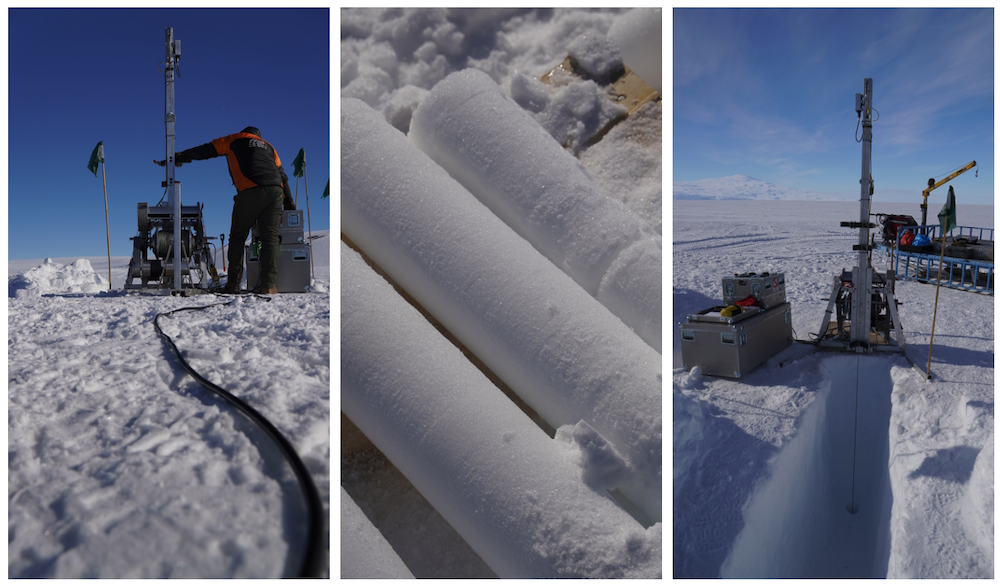
Testing the drill in Antarctica
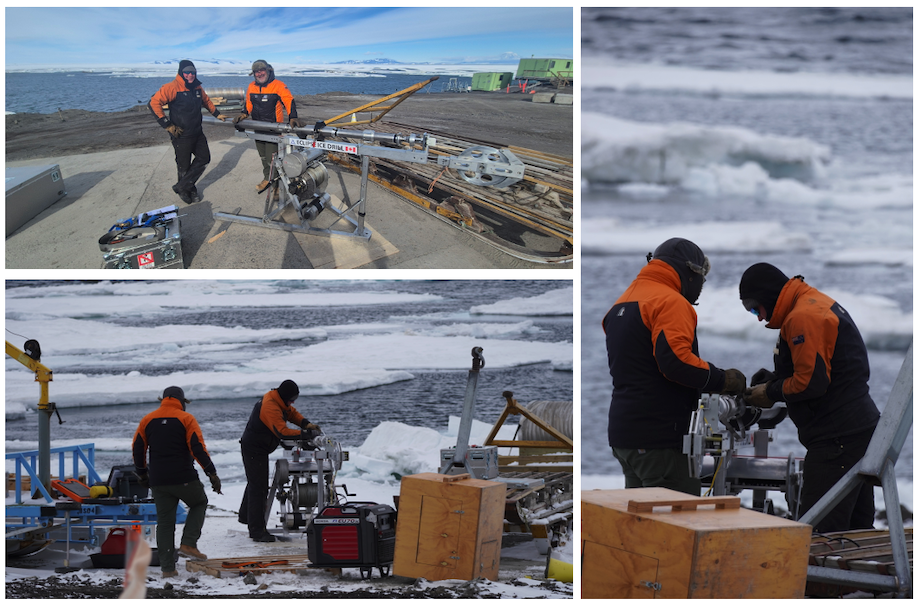
In January 2026, our team—Darcy Mandeno (drilling engineer, VUW), James MacPhail (drilling engineer, VUW) and Matt Harris (paleoclimatologist and ice core scientist, ESNZ)—were deployed to Scott Base.
In the first week, we assembled and tested the drill on a small working platform immediately in front of the base. Our focus was simple assembly and basic mechanical and electrical testing of the equipment to ensure the drill and its components were all operating as they should be.
We then transitioned to a mock field test, taking our equipment to a small testing area on the Ross Ice Shelf adjacent to the Square Frame cottage, around 10 km north of Scott Base. At each site (on base and then at the Square Frame), we assembled the drill. At Square Frame, over a couple of weeks, we drilled slowly and carefully down to a depth of around 25 m, testing the characteristics and behaviour of the drill in a variety of snow/firn density conditions (we did not try to drill deep enough to drill true ice). There is a lot of ‘feel’ to ice core drilling, so this was as much about learning for us as it was about testing the drill itself.
With only one temporary hiccup (we successfully retrieved a drill component that found itself at the bottom of the borehole!) we were very satisfied with the performance of the drill and our ability to operate it. We’re now all set for our future deployment to Whitehall Glacier, and are confident that this drill will allow us to achieve our drilling target of >250 m of core.